
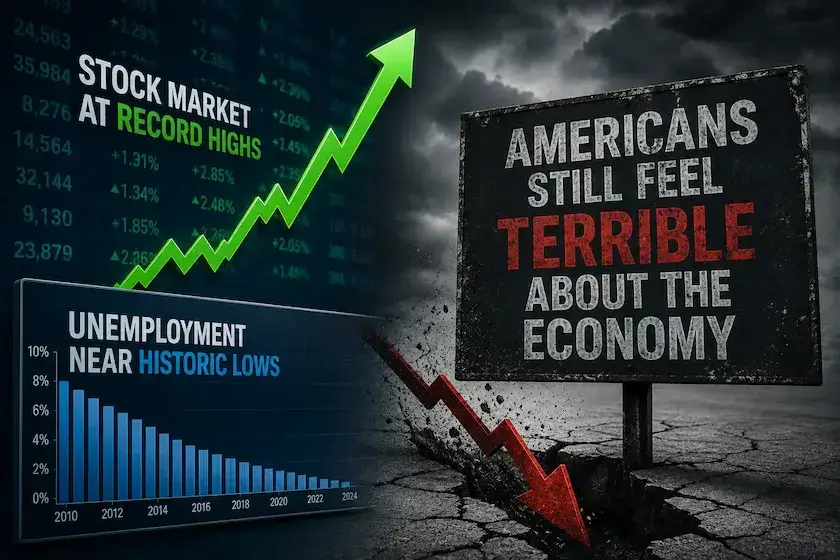
Consumer Sentiment Plunges to Lowest Level in 70 Years, But The Economy Isn’t Getting the Memo.
Roll into any suburban Ohio gas station, and the numbers greet you before you roll down your window. 4.54 per gallon today. 2.98 per gallon last February. No economist needed to explain how much changed in the meantime – tensions in Iran rose, supply chains got complex, and there was only one number reflected on the large yellow signboard.
These are sentiments economists are picking up on — the University of Michigan consumer sentiment index plunged to its lowest level ever, earlier in May, which has yet to be experienced in 2008, stagflation, or any other time. What’s particularly strange about this occurrence is that by all conventional indicators, the economy seems fine.
In a brief summary, here’s what really happened: gas prices jumped up close to 53% since the beginning of the Iran war, adding an expense to consumers’ monthly bills that almost everybody experiences regardless of the size of the paycheck or stock portfolio. That’s basically the whole gist in one paragraph, if you’re interested in a shorter version.
$4.54 a Gallon and Why Does It Mean More than Stock Prices Rallies?
As of April 2022, unemployment stood at 4.3%. Stock indexes kept growing despite the Iran war-related volatility and achieved new records. In Q4 2021, corporate profits amounted to the highest percentage of GDP on record, according to Bureau of Economic Analysis data. Finally, retail sales in March showed a significant increase.
To summarize briefly, this looks like an economy in good shape.
Unfortunately, none of these statistics appear anywhere where the average American is forced to interact with them every single day. Unlike gas prices, groceries, utilities, and many others. These expenses are affecting people’s psychology, which is unlikely to be affected positively by quarterly profit statements. And I would argue that the economists underestimate how much of a role accumulation of fatigue plays.
According to Heather Long, the chief economist at Navy Federal Credit Union, Americans are tired of the continuous period of high prices, and this latest surge produced a sentiment other than frustration among them. As she said herself, people are angry about it.
And this is an important point to linger on since tired people act different than angry ones both in terms of economics and politics.
Will This Negative Psychology Have an Impact On Consumption? It’s Not That Simple Anymore.
Ever since the pandemic disrupted the usual routine, the correlation between sentiment readings and consumer activity became rather unpredictable. In spite of the negative sentiments expressed by people, they continue making transactions, which puzzled economists, forcing them to reconsider using sentiment surveys as leading indicators.
So in that respect, a record-low reading doesn’t necessarily translate into reduced spending. This is something to emphasize clearly.
It becomes difficult to overlook, however, when taking a look at one specific index included in the May survey. Planned major purchases fell significantly, according to the latest report. According to Oliver Allen, Pantheon Macroeconomics’ senior U.S. economist, this sub-index is important as a predictor of consumer behavior. In contrast to the overall sentiment figure, it tracks actual expenditures in durable goods.
Unlike the overall sentiment figure, which shows current attitudes, this index predicts future spending on refrigerators, couches, and anything else requiring consideration. In short, when the number is declining, people are likely postponing or cancelling planned purchases.
As Mr. Allen explains, there are two main reasons why consumer spending hasn’t reflected negative sentiment readings thus far – a good tax refund season and an unusually warm spring. Both of these factors are about to lose their relevance very soon. My prediction is that May and June spending figures are going to look particularly bad. At least that’s how Oliver sounded when we talked.
What Happens When Economic Anger Looks for a Political Expression?
Midterm elections are drawing near. This is just a piece of context, no spin.
It’s not that economic dissatisfaction has never before led to political implications — it has quite a history of it. And in light of this record-breaking sentiment reading, people’s dissatisfaction comes at a time when they feel the prices for everything are too high. Predicting how and whether this will translate into votes is highly unlikely for any pundit. Maybe even impossible.
However, I’d say that the scenario under which gas prices will fall over the summer, taxes refunds have already been spent, warm weather will keep people’s spirits high, and consumer sentiment will improve without too much trouble is still possible. Maybe even probable.
But the numbers keep pointing toward May and June being months where the pessimistic assumptions will be put to the test. At some point, “we may just resolve this peacefully” sounds less like an optimistic prediction and more like a wish.
Watch Out For the Actual Numbers, Not the Sentiment Index.
In a way, sentiment index is telling you how people feel when responding to the survey. Real spending data, however, will show how they acted. This is where we are looking forward to seeing some interesting numbers.
So if you found the above analysis helpful, bookmark this page and check back when the May figures become available.
This is how the data-driven analysis should be made.